


SkinPrikyn™ Tanning Microneedle Patches ✨ 10-Minute Natural Glow ☀️ Lasts Up to 14 Days
SkinPrikyn™ Tanning Microneedle Patches ✨ 10-Minute Natural Glow ☀️ Lasts Up to 14 Days
🌿 Zero DHA · Zero synthetic fragrance · Zero oxidative stress
🧬 Sea algae biocompatible hydrogel — clean beauty certified
✨ Genetically-coded color: no orange, no yellow, only you
🛡️ 30-day full money-back guarantee — no questions asked
Today Only 🎁 Limited-Time Sale
Couldn't load pickup availability

SkinPrikyn™ Tanning Microneedle Patches ✨ 10-Minute Natural Glow ☀️ Lasts Up to 14 Days
Stop Painting Your Skin. Start Activating It.
The world’s first transdermal patch that triggers a 14-day sun-kissed glow using your body's own biological melanin. No UV. No DHA. No orange. No smell. No Sunday ritual.


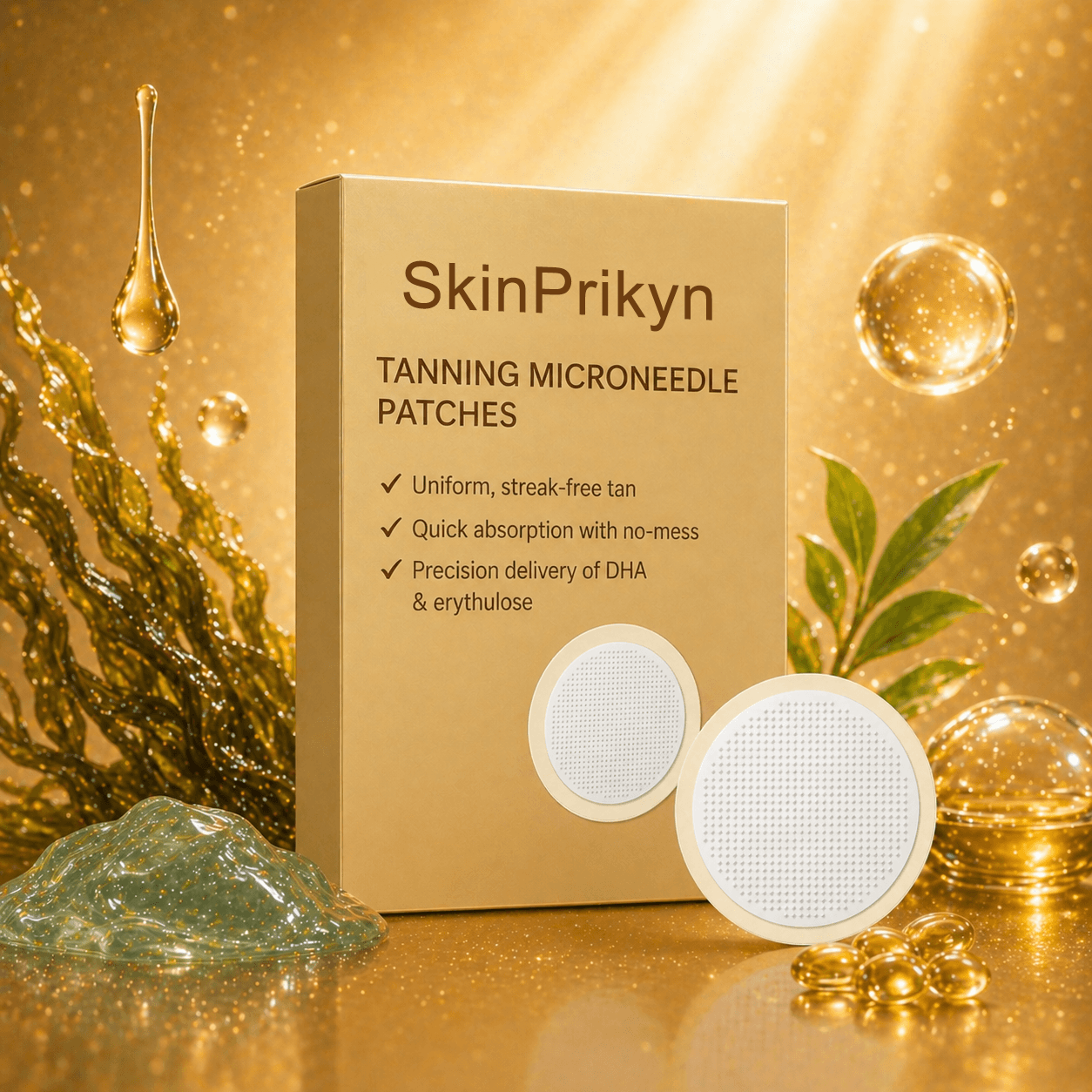

Your self-tanner is working against you. Here's why.
You already know the sun is off the table. But what no one is telling you about the "safe" alternative is that DHA — the active ingredient in every lotion, mousse, and spray tanner on the market — creates free radicals as it reacts with your skin. The same oxidative process that browns toast is happening to your face while you sleep.

The DHA Aging EffectDHA
The Maillard reaction in self-tanners produces free radicals that accelerate oxidative stress — contributing to the "crepey," dehydrated texture you notice after a few weeks of use. You're trading a glow today for older-looking skin tomorrow.

The Chemical Surface Stain
DHA only reacts with dead skin cells in the stratum corneum. It is, by design, a temporary dye on a surface that's constantly shedding — which is why it streaks, fades unevenly, and turns orange on fair skin within 72 hours.

The Maintenance Trap
Exfoliate. Apply. Wait three hours. Avoid white linen. Repeat every five days. The "Sunday tanning ritual" has become a part-time job — one that still produces results you're half-embarrassed to show up in.

The Science
A tan that happens inside your skin, not on top of it.
SkinPrikyn doesn't dye your skin. It sends a precise biological signal — the same signal your body uses when you're in sunlight — to pigment-producing cells beneath the skin’s surface. They respond by producing real eumelanin. Your own pigment. Your natural color, amplified.

① Microneedle Penetration
600-micron dissolvable needles crafted from biocompatible sea algae hydrogel pass through the stratum corneum — completely painlessly — to reach the skin layers beneath the surface.

②Peptide Delivery
MC1R agonist peptides — bioidentical analogs of your body’s natural α-MSH tanning signal — are released directly to the melanocytes, bypassing the dead surface layer entirely.

③Melanin Activation
The peptides bind to MC1R receptors, triggering a cAMP signaling cascade that activates MITF — the master switch that turns on tyrosinase and begins true eumelanin production.

④14-Day Glow Cycle
The hydrogel matrix provides a sustained, controlled release over two weeks, syncing with your skin's natural deep-tissue renewal cycle. One patch. Two weeks of glow.
Share information about your brand with your customers. Describe a product, make announcements, or welcome customers to your store.
- Derived from peer-reviewed research published in ACS Nano and the Journal of Dermatological Science.

Four ingredients. Nothing else.
Every input chosen for biological precision — not marketing. A formulation as clean as your standards demand, built around four hero actives.

MC1R Peptide MC1R
Bio-identical α-MSH analogue. The exact molecular signal your body uses to begin tanning — delivered directly.

Sea Algae Hydrogel
The biocompatible matrix that forms the dissolving microneedle. Marine-sourced, vegan, and FDA-recognized as safe.

Tyrosinase Cofactor
A trace copper-peptide complex that supports the enzymatic step where amino acids become true, deep eumelanin.

Hyaluronic Carrier
A low-molecular-weight HA layer that hydrates the dermis as the active diffuses — leaving skin plumper, not drier.

This Isn’t a Better Self-Tanner.
It’s a Different Category Entirely.
A clean, skin-first comparison between SkinPrikyn’s microneedle tanning patch and traditional DHA self-tanners.
This isn't a better self-tanner. It's a different category entirely.

Beauty that is an extension of your health, not a compromise of it.
Six reasons women are walking away from a decade of self-tanning rituals — and never looking back. Each benefit is the direct outcome of switching from chemical surface stain to biological signal.

Ten minutes, every two weeks. That's the entire commitment.
①Cleanse & dry
Choose your inner arm or inner thigh — the thinner skin in those areas allows for optimal transdermal delivery.
②Press & hold
Apply the patch with firm, even pressure for ninety seconds. The microneedles dissolve completely into the dermis.
③Remove & resume
Peel away the carrier film after ten minutes. No drying time, no streaks, no stained sheets. Your glow develops over the next 7–10 days.
what 2,400 women are saying.
-

"For the first time in my life I have a tan that I'm not embarrassed to look at in daylight. No orange, no smell, no sticky sheets. My clients keep asking if I've been to Bali. I haven't. I've been in Tel Aviv."
-

"I've spent years reading every ingredient label on every self-tanner on the market. The DHA thing is real — my skin always felt dry and dull after. Two weeks in with SkinPrikyn and I look like I've been outdoors all summer. My skin feels better than before."
-

"I travel three weeks a month and the tanning ritual was the first thing to go. Now I apply one patch before a trip and I land looking like I've already been there for a week. The 10-minute application has genuinely given me my Sunday mornings back."


Your biological glow starts today.
SkinPrikyn Tanning Microneedle Patches
- Zero DHA · Zero synthetic fragrance · Zero oxidative stress
- Sea algae biocompatible hydrogel — clean beauty certified
- Genetically-coded color: no orange, no yellow, only you
- 30-day full money-back guarantee — no questions asked
Everything you need to know.
Does it hurt? I'm worried about the needles.
Does it hurt? I'm worried about the needles.
The microneedles are approximately 600 microns — thinner than a strand of hair. They penetrate only the uppermost layer of skin and do not reach the nerve endings in the deeper dermis. The sensation, if any, is a very mild pressure — like pressing velvet against your skin. Clinical users consistently describe the application as completely painless.
Is it safe? Is it hormonal?
Is it safe? Is it hormonal?
SkinPrikyn uses targeted MC1R peptide agonists — not hormones. The delivery is localized to the application site, meaning minimal systemic exposure. Unlike illicit Melanotan-II injections, which can cause nausea, blood pressure changes, and other systemic side effects, our patch delivers a precise local signal only. The sea algae hydrogel base is biocompatible and FDA-recognized as safe.
Will it make me too dark? Can I control the result?
Will it make me too dark? Can I control the result?
Because SkinPrikyn activates your own melanocytes, it can only produce the melanin that your unique genetic profile is capable of producing. It cannot make you darker than your natural maximum — and crucially, it cannot produce the orange/yellow tones of DHA, because those are chemical byproducts, not your actual pigment. The result is always your natural color, deepened.
Where do I apply it?
Where do I apply it?
The patch is applied to the inner arm or inner thigh — areas with thinner, more permeable skin for optimal transdermal delivery. The melanin signal produced distributes naturally across the body over 7–10 days. You do not need to apply it to every area you want to tan.
How does the cost compare to regular self-tanners?
How does the cost compare to regular self-tanners?
A single patch lasts 14 days. That's two patches per month — compared to a weekly (or more frequent) self-tanning routine that requires mousse, mitts, exfoliating gloves, and the hidden cost of stained linen. When you account for total product spend, prep time, and the products you currently buy to manage the inevitable DHA damage, SkinPrikyn is consistently less expensive — and infinitely less effortful.